You Already Know How to Run a Good Virtual Meeting. Here Is Why You Are Not Doing It.
78% of workers say meetings prevent real work. Camera-on can increase fatigue, while camera-off can reduce how engaged you appear. The problem is not knowledge. It is that obvious best practices feel optional under pressure.
“Could You Please Repeat That?”
You have heard it in every virtual meeting. Someone’s name is called. A pause. Then: “Sorry, could you repeat that? I missed the last part.”
Everyone on the call knows what happened. The person was not listening. They were reading a Slack message, scanning an email, or working on something else entirely. The meeting continued around them, and when their attention was requested, they had nothing to offer except an apology.
I have been that person. More than once. And I have sat in hundreds of meetings where others were that person. What strikes me is not that it happens. It is that everyone involved, the drifter and the witnesses, knows exactly what went wrong and does nothing to change the system that produces it.
That is the paradox this essay is about. Virtual meeting best practices are not a secret. Camera on, mute when not talking, have an agenda, do not multitask. Every professional who has survived the last five years of remote work can recite the list. The problem is not knowledge. The problem is that knowing what works and consistently doing what works are two entirely different things.
The Numbers That Should Change Your Behavior (But Probably Will Not)
Microsoft’s 2025 Work Trend Index found that employees are interrupted every two minutes during core work hours, with the total reaching roughly 275 interruptions across the full day. Even for the median worker, the volume is relentless.
Gloria Mark’s research at the University of California, Irvine found that it takes an average of about 23 minutes to fully resume interrupted work. Taken together, these studies show why modern meeting culture feels cognitively unsustainable, though the figures come from different datasets and should not be combined too literally.
Atlassian surveyed 5,000 knowledge workers and found that 78% say meetings prevent them from getting their work done. 62% attend meetings where no goal was stated in the invite. 76% feel drained on days with lots of meetings. Over half work overtime because meetings consumed their productive hours.
And here is the part that should make you close your laptop and go for a walk: research suggests very few people can multitask without meaningful performance loss. The people checking Slack during a meeting are not saving time. They are losing productive capacity to attention switching, and the meeting gets neither their focus nor their contribution.
You already knew most of this. You are still going to check Slack in your next meeting. That is the problem.
Your Environment Sets Your Ceiling
Before we talk about behavior, we need to talk about where you sit. Your physical setup determines the upper bound of your meeting effectiveness, and most people have never thought about it deliberately.
Natural light is not a luxury. Research from Human Spaces shows that workspaces with natural elements (light, plants, water features) are associated with 15% higher wellbeing, 6% higher productivity, and 15% higher creativity. A 2014 Northwestern study found that workers in windowless offices slept approximately 46 minutes less per night than those with windows.
Less sleep means less energy, which means less engagement, which means more “could you repeat that” moments.
The basement home office problem. A systematic review of physical home workspace characteristics and mental health found that light and daylight were the most frequently studied factor, linked to productivity in eight studies and sleep quality in seven. If you work from a basement or a windowless room, you are operating under a compounding deficit: less light leads to worse sleep, which leads to lower energy, which leads to less engagement, which leads to worse meeting performance. The cycle reinforces itself daily.
What to do about it:
- Position your desk so natural light comes from the side, not behind you (backlighting makes your face dark on camera) and not directly in front (glare on your screen)
- If you have no natural light, invest in a daylight-mimicking LED panel (5000-6500K color temperature). For a windowless workspace, this is one of the simplest improvements you can make.
- Face a simple background, not a window behind your screen. Movement in your peripheral vision pulls your attention involuntarily.
These are not aesthetic choices. They are performance infrastructure. You would not run a production database on a laptop with a dying battery. Do not run your professional presence on a setup that actively degrades your cognitive performance.
The Camera Decision Is Not Simple
The research on cameras is genuinely mixed, and the “just turn your camera on” advice oversimplifies real trade-offs.
On one hand: a 2025 study in the European Journal of Social Psychology found that in small-group virtual interactions, turning the camera off led participants to be perceived as less engaged and less suitable for leadership roles.
A Vyopta analysis of 40 million meetings found a correlation between camera usage and retention: employees who left within a year had cameras on in only 18.4% of small meetings, compared to 32.5% for those who stayed. This is correlational, not causal; people already disengaging may simply turn cameras off more often.
On the other hand: research published via SHRM found that camera-on participants report more fatigue, which correlates with less voice and less engagement. A Nature study published in 2024 found that fatigued individuals show increased conformity, meaning camera fatigue may actually reduce independent thinking. These effects are stronger for women and newer employees.
A note on camera norms: they are not neutral. Bandwidth limitations, caregiving responsibilities, disability, neurodiversity, and workspace privacy all affect whether camera-on is reasonable. Any camera policy should account for these realities rather than treating camera-on as a universal default.
The practical resolution: Camera on is not always the right answer, and camera off is not always wrong. The decision should be intentional:
| Meeting type | Camera recommendation | Why |
|---|---|---|
| Small group discussion (2-6 people) | On | Your presence and reactions shape the conversation |
| One-on-one with your manager or direct report | On | Trust and relationship require visibility |
| Presentation to a large audience (20+) | Off unless speaking | Your camera is one tile among dozens; the cognitive cost outweighs the signal |
| Back-to-back meetings (3+ in a row) | Off for at least one | Fatigue accumulates; strategic camera breaks preserve energy for the meetings that matter |
| Meeting where you need to influence a decision | On | The perception data is clear: camera-off reduces your influence |
One more thing: turn off self-view. Stanford’s Jeremy Bailenson identified constantly seeing yourself as one of four causes of Zoom fatigue. You do not stare at a mirror during in-person meetings. Turning off the self-view tile (not your camera, just the mirror) reduces cognitive load with zero downside.
The Multitasking Lie
You are not multitasking. You are switch-tasking, and it is costing you more than you realize.
When you read a Slack message during a meeting, your brain does not process both the message and the meeting simultaneously. It drops the meeting, processes the message, and then struggles to fully re-engage. Even brief context switches create measurable re-entry costs and what researchers call attention residue: part of your mind stays anchored to the Slack message even after you look back at the screen.
Sophie Leroy’s research on attention residue shows this is not a willpower problem. It is a structural feature of how human cognition works. You cannot overcome it with discipline. You can only overcome it with environment design: close the tabs, silence the notifications, and put your phone face down before the meeting starts.
This is where inversion thinking applies directly. Ask yourself: “What would guarantee I am the least useful person in this meeting?” The answer writes itself: keep Slack open, leave email visible, check my phone under the desk, wait until my name is called to engage. If that list describes your default meeting posture, you have identified the system that needs changing.
The Confession: What I Actually Do When a Meeting Dies
I need to be honest about something, because if I am not, this article becomes the kind of advice that sounds good but does not survive contact with reality.
Sometimes I am in a 60-minute meeting, and by minute 20, I can feel it is not going anywhere. People have gone off on a tangent. The discussion is circular. Two participants are debating something that will not get resolved in this forum. With enough experience, you develop a sense for when a meeting has lost its trajectory. The signals are clear: the same point gets restated in different words, nobody is taking notes anymore, and the facilitator has stopped managing the clock.
When this happens, I turn off my camera. I start doing something else. I tell myself I will rejoin when the conversation comes back around. And then, somewhere in the last 10 or 15 minutes, my name is called. “Vikas, what do you think?”
“Could you please repeat that?”
I am writing an article about how to avoid being that person, and I am that person. That is the point. The problem is not that people do not know better. The problem is that knowing better does not survive a meeting that has lost its purpose at minute 20.
What I have learned is that there are really only three honest options when a meeting dies:
Option 1: Redirect. If you have enough standing in the meeting, say it: “I think we have drifted from the agenda. Can we table this and focus on the decision we need to make?” This takes courage, but every person in the meeting will silently thank you for it.
Option 2: Leave. “I do not think I can add value to the rest of this discussion. I will catch up on the notes. Let me know if there is an action item for me.” This is harder than it sounds, but it is more respectful than staying and disengaging.
Option 3: Stay and own the cost. If neither redirect nor leaving is an option (the meeting is with a client, or with leadership, or the dynamics do not allow it), then stay and stay present. Accept that the next 40 minutes will not be productive on any other task. Do not pretend you can multitask your way through it. The cost of “could you repeat that” in front of a client or a VP is higher than the cost of 40 less-than-ideal minutes.
What does not work is the fourth option, which is the one I default to: stay, disengage, pretend to be present, and get caught. That option has all the costs and none of the benefits.
Meeting Culture: The System Around the Meeting
Individual discipline helps, but it cannot fix a broken meeting culture. The deeper problem is incentives: meeting costs are socialized across everyone’s calendar, attendance is rewarded more visibly than focused output, and nobody owns the downside of fragmentation. If your organization schedules meetings with no agenda, invites people who do not need to be there, and fills calendars from 8 AM to 6 PM with no protected focus time, the best meeting habits in the world will not save you.
The organizations that have addressed this see dramatic results:
Shopify canceled all recurring meetings with three or more people in 2023 and instituted “no meeting Wednesdays.” They cut 12,000 events from their calendars, equivalent to 36 years of meeting time. Early internal estimates suggested meaningful gains in project throughput, though the long-term impact is harder to isolate.
A survey-based study of 76 companies by NEOMA Business School found that employee-rated productivity rose sharply when meetings were reduced, with the strongest gains coming from two meeting-free days per week. Autonomy, communication, and employee satisfaction also improved. Stress and micromanagement decreased.
A caveat on all these numbers: Microsoft, Atlassian, Vyopta, and NEOMA each have their own methodologies and sample constraints. These are directional indicators, not universal constants. They point in the same direction, but any single figure should be treated as evidence, not proof.
You do not need to cancel all your meetings. But you can apply the inversion question to your calendar: “Which of these meetings would guarantee a wasted hour?” The one without an agenda. The one where you are invited “for visibility” but have no action item. The weekly recurring that nobody has questioned since 2023. Start with those.
The Meeting You Should Not Be In
Before you optimize how you show up, decide whether you should show up at all.
This requires a habit most professionals resist: ruthlessly challenging yourself before accepting every meeting invite. Two questions, asked honestly, will save you hours every week:
“Am I needed, or am I just invited?” There is a difference between being a required participant (you have context others need, you need to make a decision, you will leave with an action item) and being an audience member (you are there “for visibility” or “to stay in the loop”). If your role is purely to listen, you do not need to be there. You need the output.
“Will I contribute, or will I just absorb?” If you already know you will be in listening mode for the full 30 or 60 minutes with nothing to add, that is a signal to decline and ask for the notes instead.
The decline does not have to be confrontational. “I trust you to run this. Could you share meeting notes or let me know if there is an action item for me afterward?” is collaborative, not dismissive. It says: I respect the meeting enough to not dilute it with my passive presence.
Most teams that run good meetings already produce meeting minutes and action items. If your team does this, you have a built-in mechanism to stay informed without attending. If your team does not do this, that is a bigger problem than your attendance.
The math is simple. If you decline two unnecessary 30-minute meetings per week, you reclaim 52 hours per year. That is more than a full work week returned to you, just by asking “am I actually needed?” before clicking Accept.
A note on context: much of this decline advice comes from my experience as a full-time employee at Expedia, where I had real control over which meetings to accept and which to push back on. In my current consulting role, the dynamics are different. When a client sets a meeting, you attend. The question shifts from “should I be in this meeting” to “how do I make sure I am fully present for it.” If you are in a client-facing or early-career role, the decline advice may not apply directly. But the preparation and presence advice applies everywhere. You may not control which meetings you attend, but you always control how you show up.
The System
This is a systems problem, not a goals problem. The goal “be more effective in meetings” is as useless as the goal “lose ten pounds.” It tells you where to point but not how to get there.
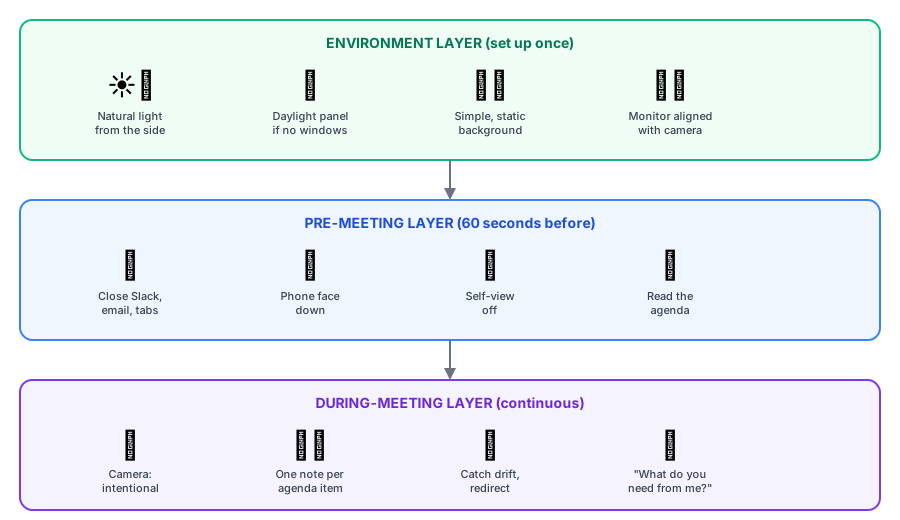
The system has three layers:
Environment layer (set up once, benefits every meeting):
- Desk positioned for natural light from the side
- Daylight-mimicking panel if no windows
- Simple, static background
- Second monitor arranged so you are not turning away from the camera to read notes
Pre-meeting layer (60 seconds before each meeting):
- Close Slack, email, and all non-meeting tabs
- Put phone face down or in another room
- Turn off self-view
- Read the agenda (if there is one; if there is not, ask for one)
During-meeting layer (continuous):
- Camera decision: intentional, not defaulted (use the table above)
- If you catch yourself drifting, name it internally and redirect. Do not pretend it did not happen.
- Take one note per agenda item. The act of writing anchors attention more than passive listening.
- If you do not know why you are in this meeting, ask. “What do you need from me in this meeting?” is not rude. It is respectful of everyone’s time.
The system runs every day. Some days you execute it perfectly. Some days you check Slack under the desk. The point is that the system exists, and when you drift, you have something to return to rather than starting from scratch.
Do Next
| Priority | Action | Why it matters |
|---|---|---|
| Today | Close Slack and email before your next meeting. Just once. Notice how different the meeting feels. | You cannot change your meeting culture overnight, but you can change the next 30 minutes. The contrast between a focused meeting and a fragmented one is the most persuasive argument for the system. |
| This week | Audit your workspace lighting. Sit at your desk, look at where the light comes from, and assess: is natural light hitting your face, your back, or not reaching you at all? | Most people have never deliberately evaluated their meeting setup. A 5-minute lighting audit often reveals that a simple desk rotation or a $50 lamp would materially improve how they appear and feel on camera. |
| This week | Turn off self-view (not your camera) for an entire day of meetings. | Stanford research says the self-view mirror is one of four causes of Zoom fatigue. Removing it costs nothing and most people report feeling noticeably less drained by end of day. |
| This month | Apply the inversion question to your recurring meetings: “Which of these would guarantee a wasted hour?” If you have calendar autonomy, decline or restructure the ones that make the list. If you are in a client-facing role, focus on making those meetings count. | Every professional has at least two meetings on their calendar that no longer serve their original purpose. Shopify cut 12,000 recurring events. You do not need to be that aggressive, but the question is worth asking. |
| This month | Propose one meeting-free afternoon per week to your team. | NEOMA’s survey-based research found sharp productivity gains with meeting-free days. Even a half-day creates a protected block for deep work that meetings currently fragment. |
Stay in the loop
Get new articles on data governance, AI, and engineering delivered to your inbox.
No spam. Unsubscribe anytime.