The Evolution of AI Agents: From AutoGPT to Production (2023-2026)
A practitioner's timeline of how AI agents evolved from viral GitHub demos to production infrastructure in three years. The hype, the correction, the protocols, and the lessons that survived.
The Agent That Needed Thirty Iterations
I built a daily intelligence briefing agent in early 2026. The idea was simple: scan AI research, key voices, and industry news every morning, then deliver a curated summary tuned to my interests. The first version was terrible.
It surfaced generic headlines I had already seen. It missed the niche voices I actually follow. It buried the practitioner-oriented content I care about under a wall of press releases. The core loop worked. The judgment was absent.
So I started iterating. I added a preference file the agent reads on every run. I built a weekly learning cycle that analyzes my feedback (what I clicked, what I ignored, what I explicitly flagged) and updates those preferences automatically. Over roughly thirty iterations across a few weeks, the agent became genuinely useful. Not because the underlying model improved, but because the outer feedback loop gave it enough signal to learn what “good” means for my specific context.
That experience captures the entire arc of AI agents from 2023 to 2026 in miniature. The first version of any agent is disappointing. The pattern that matters is not the initial demo; it is the feedback loop that allows the system to improve over time. Agents do not work out of the box. They need iteration, evaluation, and tuning.
What follows is the chronological story of how the industry learned that lesson the hard way.
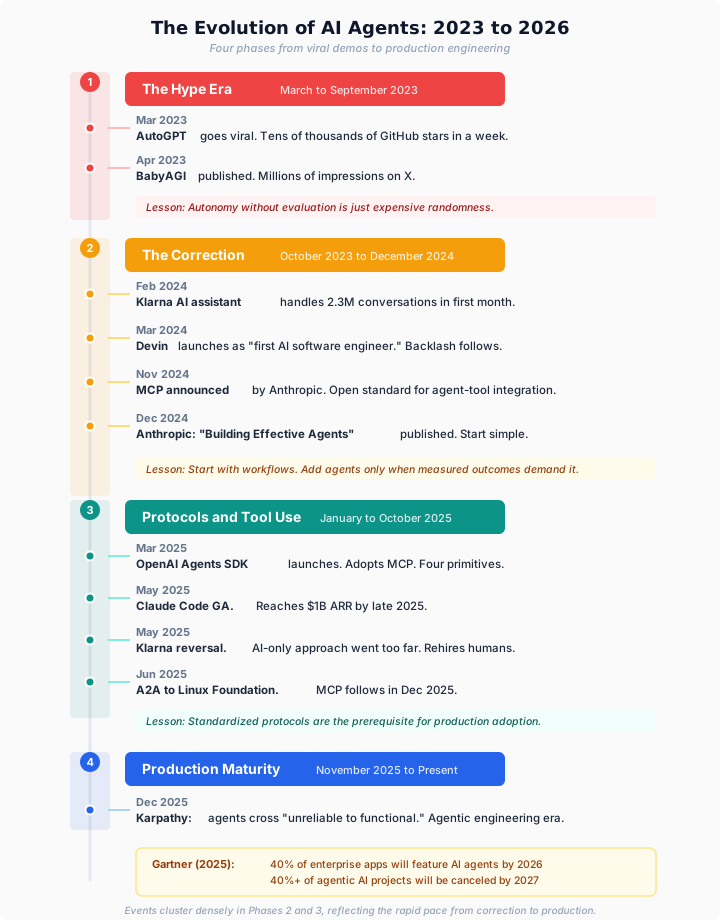
Phase 1: The Hype Era (March to September 2023)
On March 30, 2023, Toran Bruce Richards released AutoGPT on GitHub. The concept was electric: give GPT-4 the ability to call itself recursively, manage its own task list, and work toward goals without human intervention. Within a week, it had accumulated tens of thousands of GitHub stars. By mid-April, it was the top trending repository on the platform.
Days later, in early April 2023, venture capitalist Yohei Nakajima published BabyAGI, a stripped-down autonomous agent that orchestrated a loop of task creation, execution, and prioritization using an LLM and a vector store. It went viral on Twitter with millions of impressions. The race was on.
Andrej Karpathy amplified AutoGPT early on X, driving a massive surge in visibility. ChaosGPT, an experiment where someone pointed an autonomous agent at destructive objectives, made headlines for all the wrong reasons. The narrative was intoxicating: autonomous AI agents would handle everything from coding to research to business strategy. You just needed to give them a goal and let them run.
The reality was different. AutoGPT had a well-documented tendency to get stuck in infinite loops, hallucinate confidently, and burn through API credits at alarming rates. Early reviewers described it as “too autonomous to be useful.” Context windows were small. There were no evaluation frameworks, no guardrails, no observability. The agent would spin for hours, generating plans within plans, executing none of them reliably.
By October 2023, Significant Gravitas raised $12 million in venture funding, but the fundamental problems remained unsolved. The hype era established a pattern that would repeat: impressive demos, viral growth, and then the collision with production reality.
The lesson from Phase 1 was blunt: autonomy without evaluation is just expensive randomness.
Phase 2: The Correction (October 2023 to December 2024)
The correction happened on two fronts. First, the spectacle of overreach. Second, the quiet emergence of discipline.
On March 12, 2024, Cognition Labs launched Devin, billed as “the first AI software engineer.” The demo video went viral with over 30 million views on X. On the SWE-bench benchmark, Devin resolved 13.86% of real GitHub issues unassisted, compared to the previous state-of-the-art of 1.96% unassisted. The company secured $21 million in funding.
Then the backlash arrived. YouTube channels like Internet of Bugs exposed significant flaws in Devin’s promotional materials. The agent struggled with complex code, created unnecessary abstractions, and showed inconsistent task performance. Devin was real progress on benchmarks but not yet production-ready for the work it claimed to replace.
Meanwhile, the Klarna story was becoming a cautionary tale for the enterprise. In February 2024, Klarna announced its OpenAI-powered AI assistant had handled 2.3 million customer conversations in its first month, doing the work of 700 full-time agents and cutting resolution time from eleven minutes to under two. OpenAI’s case study said the assistant was anticipated to drive $40 million in profit improvement in 2024. It looked like the agent revolution had arrived. We will return to what happened next.
The more durable contribution of this period came in December. On December 19, 2024, Anthropic published “Building Effective Agents”, a blog post that became the field’s course correction manifesto. The core message was direct: “Start with simple prompts, optimize them with comprehensive evaluation, and add multi-step agentic systems only when simpler solutions fall short.”
Anthropic had worked with dozens of teams building agents across industries and found that the most successful implementations did not use complex frameworks or specialized libraries. They used simple, composable patterns: prompt chaining, routing, parallelization, orchestrator-workers, evaluator-optimizer loops, and only then autonomous agents. The post drew a sharp line between “workflows” (predefined code paths) and “agents” (dynamic LLM-directed processes). Most applications, they argued, needed workflows, not agents.
For practitioners: The Anthropic “Building Effective Agents” post is the single most important document from this entire timeline. If you read one external source, read that one. The argument for knowing when NOT to build an agent starts here.
Simon Willison praised the post extensively, and the broader community treated it as the antidote to the framework-complexity trap. The lesson: if your agent architecture requires a whiteboard to explain, you have probably skipped the simpler solution that would actually work.
Phase 3: Protocols and Tool Use (January to October 2025)
If Phase 2 was about what not to build, Phase 3 was about building the plumbing that makes agents actually work.
The foundation was laid a month before Phase 2 ended. On November 25, 2024, Anthropic announced the Model Context Protocol (MCP) as an open standard for connecting AI systems to external data and tools. Before MCP, every team building an agent had to write custom connectors for each data source, creating what Anthropic described as an “N-times-M” integration problem. MCP standardized the interface.
Most teams wrote it off initially as another standard that would die in committee. Then adoption accelerated rapidly.
On February 2, 2025, Karpathy coined “vibe coding” in a post on X: “There’s a new kind of coding I call ‘vibe coding,’ where you fully give in to the vibes, embrace exponentials, and forget that the code even exists.” The term captured a real shift: AI-assisted coding had crossed a usability threshold. By March, Y Combinator reported that 25% of its Winter 2025 cohort had codebases that were roughly 95% AI-generated.
On March 11, 2025, OpenAI launched the Agents SDK, replacing its experimental Swarm framework with a production-ready toolkit. The design was deliberately minimal: four core primitives (Agent, Handoff, Tool, Guardrail) instead of a sprawling framework. Two weeks later, OpenAI announced MCP support, initially available in the Agents SDK, with Responses API and ChatGPT desktop support announced as coming. Sam Altman posted: “People love MCP and we are excited to add support across our products.”
Anthropic’s Claude Code entered limited research preview in February 2025 and reached general availability by May. It took a different approach from traditional coding assistants: rather than autocompleting lines in an IDE, it ran in the terminal, interacting directly with the file system, running commands, and managing entire workflows. By late 2025, Claude Code had reached a $1 billion annualized revenue run rate within roughly six months of its GA launch.
On April 9, 2025, Google announced the Agent2Agent (A2A) protocol with support from over 50 technology partners including Atlassian, Salesforce, SAP, and ServiceNow. Where MCP solved the agent-to-tool connection, A2A addressed agent-to-agent communication. The two protocols were explicitly designed as complements, not competitors.
In June 2025, A2A was donated to the Linux Foundation. MCP followed in December 2025, when Anthropic donated it to the Agentic AI Foundation (a Linux Foundation directed fund co-founded by Anthropic, Block, and OpenAI). The coalescing of Anthropic, OpenAI, Google, and Microsoft around common protocols was the clearest sign that agents had moved from science project to engineering discipline.
What this looks like in practice. The protocol stack (MCP for tool integration, A2A for agent coordination) mirrors what happened with web standards in the 1990s and API standards in the 2010s. Standardization is not exciting, but it is the prerequisite for production adoption. For deeper coverage, see the related reading section below.
In the middle of this build-out, Klarna’s earlier triumph was unraveling. By May 2025, CEO Sebastian Siemiatkowski admitted the AI-only approach went too far. Customer satisfaction had dropped. Complex issues overwhelmed agents trained on routine queries. Siemiatkowski was blunt: “As cost unfortunately seems to have been a too predominant evaluation factor when organizing this, what you end up having is lower quality.” Klarna began rehiring human agents, pivoting to a hybrid model.
The Klarna reversal became the most cited case study for a principle practitioners were learning independently: agents need quality layers, evaluation hierarchies, and guardrails. Optimizing for cost alone produces brittle systems.
Phase 4: Production Maturity (November 2025 to Present)
In December 2025, Karpathy wrote in his Year in Review that coding agents had crossed from “unreliable to functional.” His workflow had inverted from 80% manual coding to 80% agent delegation. By early 2026, he described the shift from vibe coding to something more rigorous: “Vibe coding is now passe… the new default is that you are not writing the code directly 99% of the time, you are orchestrating agents who do.” He called the new discipline “agentic engineering.”
That reframing captures the broader industry shift. Agents in production require the same engineering rigor as any other software: observability, prompt engineering for production contexts, Data Quality measurement, and clear decision frameworks for when agents are the wrong choice.
The framework landscape consolidated. In October 2025, Microsoft merged AutoGen with Semantic Kernel into a unified Microsoft Agent Framework. LangChain publicly told developers to use LangGraph for agents, not the original LangChain library. OpenAI’s approach of building harnesses rather than frameworks reflected a preference for thin orchestration layers over monolithic agent platforms.
Gartner’s data from this period tells a dual story. In August 2025, they predicted 40% of enterprise apps would feature task-specific AI agents by 2026, up from less than 5% in 2025. That same summer, they predicted over 40% of agentic AI projects would be canceled by 2027 due to escalating costs, unclear business value, or inadequate risk controls. Both predictions can be true simultaneously: adoption is expanding fast, and most early projects lack the engineering discipline to survive.
Gartner also identified “agent washing”: vendors rebranding chatbots, RPA tools, and AI assistants as “agents” without meaningful agentic capabilities. By September 2025, they placed AI agents at the Peak of Inflated Expectations on their Hype Cycle.
For practitioners: The 40% cancellation prediction should not discourage you from building agents. It should motivate you to start with evaluation before you start with features. The teams that survive are the ones that know what their agent is supposed to do well and can prove it quantitatively.
The maturity pattern shows up in my own work. The daily briefing agent I described at the start of this article is a Phase 4 system. It has a context engineering layer (preferences, source configuration, prompt templates), an evaluation loop (weekly feedback analysis), guardrails (topic filters, source quality checks), and observability (logs of what was surfaced, what was clicked, what was ignored). None of that existed in the first version. All of it is necessary for the agent to be worth running daily.
For a complete walkthrough of building an agent with these production patterns, see the end-to-end implementation guide.
Lessons Timeline
| Year | Event | Lesson | Data Praxis Article |
|---|---|---|---|
| Mar 2023 | AutoGPT goes viral on GitHub | Autonomy without evaluation is expensive randomness | What Is an AI Agent |
| Apr 2023 | BabyAGI goes viral | The loop is the innovation, not the model | Pike’s Rules for Agents |
| Mar 2024 | Devin launches, backlash follows | Benchmark performance does not equal production readiness | When NOT to Build an Agent |
| Feb 2024 | Klarna claims 700-agent replacement | Cost savings without quality measurement creates debt | The Missing Quality Layer |
| Dec 2024 | Anthropic: “Building Effective Agents” | Start simple. Add complexity only when data demands it | Evals: How to Know Your Agent Works |
| Nov 2024 | MCP announced | Standardized tool integration unlocks ecosystem adoption | Context Is the Program |
| Mar 2025 | OpenAI Agents SDK launches | Production agents need guardrails and tracing as primitives | Guardrails and Safety |
| May 2025 | Klarna reverses AI-only strategy | Agents need human-in-the-loop for complex, emotional tasks | Agent Observability |
| Dec 2025 | Karpathy: agents cross “functional” threshold | The shift is from writing code to orchestrating agents | Vibe Coding to Agentic Engineering |
| 2026 | Production maturity, framework consolidation | Context engineering, harness design, and self-improvement are table stakes | Harness Engineering |
What Comes Next
Three trends are converging for the next phase.
Agent-to-agent coordination becomes real. Both MCP and A2A are now under the Linux Foundation. The protocol layer is stabilizing. The next frontier is not single agents performing tasks, but specialized agent teams coordinating across boundaries: a code agent hands off to a test agent, which escalates failures to a debugging agent, with a governance agent monitoring the entire chain.
Self-improving systems move from experiment to expectation. The pattern I described with my briefing agent, where the system learns from accumulated feedback, is becoming a recognized architectural pattern. Agents that cannot improve from their own operational data will be replaced by agents that can.
AI Governance catches up. Gartner’s 40% cancellation prediction is partly a governance story. Organizations that deploy agents without clear boundaries, audit trails, and evaluation frameworks will hit the same wall Klarna hit. The teams that treat AI Governance as a first-class engineering requirement, not a compliance checkbox, will be the ones still running agents in production a year from now.
The Arc
Three years. Four phases. One pattern.
The agents field moved from viral demos (2023) to painful correction (2024), from protocol standardization (early 2025) to production engineering (late 2025 and 2026). Few recent software categories have moved this quickly.
But the pattern itself is not new. Every technology follows the same arc: hype, correction, infrastructure, production. What makes agents different is the feedback loop at the center of the architecture. A web framework does not learn from its users. A database does not get better at queries by watching which ones fail. Agents, if built with the right feedback mechanisms, do.
The practitioners who will thrive in the next phase are not the ones who adopted agents earliest. They are the ones who learned to build the evaluation layer first, measure quality continuously, and add complexity only when the data demanded it.
That is what the last three years taught us. The next three will test whether we actually learned it.
Related Reading from The Data Praxis
Understanding agents: What Is an AI Agent (and What Isn’t?) | When NOT to Build an Agent | Pike’s Rules for Agent Development
Building agents: From Vibe Coding to Agentic Engineering | Prompt Engineering for Production Agents | Build a Real Agent This Weekend
Quality and safety: Evals: How to Know If Your Agent Works | Guardrails and Safety | The Missing Quality Layer | Data Quality Problem in AI Agents
Architecture: Context Is the Program | Context Engineering, Formalized | Harness Engineering | Agent Observability | Self-Improving Agent Systems | Willison’s Agentic Engineering Patterns
For a structured guide through the complete agent engineering stack, see The Practitioner’s Guide to AI Agents (11 parts, ~120 minutes total reading time).
Sources & References
- Wikipedia: AutoGPT(2023)
- Yohei Nakajima: Birth of BabyAGI(2023)
- Anthropic: Building Effective Agents(2024)
- Wikipedia: Model Context Protocol(2024)
- OpenAI: Klarna AI Assistant Case Study(2024)
- VentureBeat: Cognition Emerges from Stealth to Launch Devin(2024)
- Wikipedia: Devin AI(2024)
- Anthropic: Introducing Computer Use(2024)
- OpenAI: New Tools for Building Agents(2025)
- Google Developers Blog: A2A Protocol(2025)
- Gartner: Over 40% of Agentic AI Projects Will Be Canceled by 2027(2025)
- Gartner: 40% of Enterprise Apps Will Feature AI Agents by 2026(2025)
- Wikipedia: Vibe Coding(2025)
- Karpathy: 2025 LLM Year in Review(2025)
- Entrepreneur: Klarna CEO Reverses Course by Hiring More Humans(2025)
- The New Stack: Vibe Coding Is Passe(2026)
Stay in the loop
Get new articles on data governance, AI, and engineering delivered to your inbox.
No spam. Unsubscribe anytime.